This is Part 7 of 7 in Embracing the Challenge: Questions and Answers in Music and Worship in Christian Higher Education
I believe that the questions addressed in this paper encapsulate the substantial challenges that face those of us who strive to train musicians and worship leaders to serve the local church. The trends are clear — we must adapt or we will cease to exist as independent programs. In light of this existential challenge, we must reconsider our calling as educators and as ministers in the local ecclesial community. Just as our field has undergone change, so must our self-consideration. We must reimagine ourselves as trusted guides for our students’ journeys along their vocational paths. We are not bearers of secret knowledge that must be carefully bequeathed to the next generation in a similar manner it was given to us. We must provide our students with the musical, theological, and philosophical paths to confidently launch into the tumultuous waters of church, culture, and a global community.
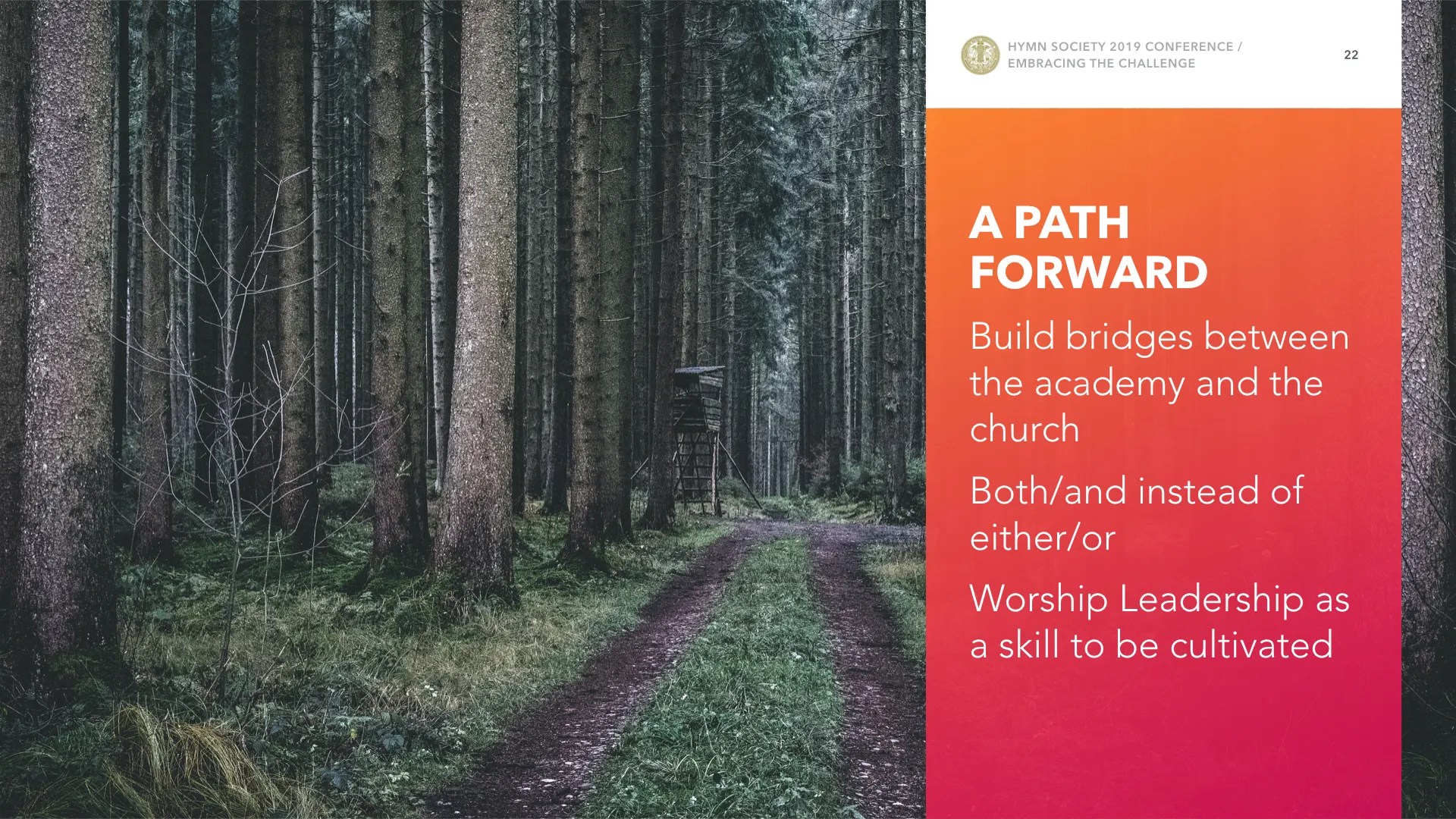
In order to do this, our institutions must build bridges between the academy and the local church. This means opening a bi-directional dialogue where we listen to the needs and ideas of pastors and musicians and then offer fresh perspectives and ideas. Our students need professional mentors who will commit to walk with through the mundane and the spectacular. Classroom instruction must be combined with field work, ministry supervision, and constructive feedback. Rather than a degree requirement that is fulfilled at the end of a course of study, these internships and learning opportunities must permeate the curriculum at every stage. Again, this takes courage for institutions to admit that they cannot solely provide the education our students need. We model biblical principles of community, fellowship, and mutual submission when we prioritize the local church community in our programs. Our classes then become an environment for discussion and engagement, and not merely the vehicles for the delivery of academic content.
Secondly, we must embrace the mentality of “both/and” and not “either/or.” If the worship wars of the past decades have taught us anything, they have shown us that when one position wins, everyone loses. The focused study of God’s nature and actions will invariably overflow in praise and worship of the God who saves. We see this clearly in the Pauline epistles where he punctuates lengthy expositions of theological truth with outbursts of doxology, “Oh, the depth of the riches and wisdom and knowledge of God! How unsearchable are his judgments and how inscrutable his ways. . . . For from him and through him and to him are all things. To him be glory forever. Amen” (Romans 11:33, 36). Likewise the passionate worship of God on the mouths of believers fuels their desire to know more fully the one whom they worship. These twin pillars must bear the weight of our programs of study; and music can serve as the link that carries both the truth of the Word of God and the praises of his people.
Finally, we must reimagine worship leadership as a skill that must be cultivated, not simply as knowledge that must be comprehended. Just as those called to exposit God’s Word need opportunities to preach and receive meaningful feedback, our students of music and worship leadership must have these same benefits. Our programs need lab environments in which our students encounter a variety of musical, liturgical, and cultural expressions of worship and learn how to faithfully handle the Word of God in these environments. They need safe places where they can fail in their leadership and receive gentle correction and the chance to try again. When we combine the academic knowledge of theology and music with the praxis of worship leadership, we are truly preparing our students for a lifetime of ministry.
The challenges facing graduate music and worship training in theological education are substantial. Seminaries and other theological institutions must confidently innovate and imagine new opportunities to shape the beliefs and practices of students and churches. We know that the task can only be accomplished through the empowering work of the Holy Spirit in and through us. The words of the Fred Pratt Green hymn, “When in Our Music God is Glorified” provide a vision of what this future can be — one where music and theology are wed to produce a Church that reflects the image of the the Son of God and offers its praise to the Triune God of Grace.
When in our music God is glorified,
And adoration leaves no room for pride,
It is as though the whole creation cried:
Alleluia!
How oft, in making music, we have found
A new dimension in the world of sound
As worship moved us to a more profound
Alleluia!
So has the Church, in liturgy and song,
In faith and love, through centuries of wrong,
Borne witness to the truth in ev’ry tongue:
Alleluia!
And did not Jesus sing a psalm that night
When utmost evil strove against the light?
Then let us sing, for whom he won the fight:
Alleluia!
Let ev’ry instrument be tuned for praise;
Let all rejoice who have a voice to raise,
And may God give us faith to sing always:
Alleluia!
Check out the other posts in the Embracing the Challenge series:
- Introduction
- Question 1: What is the relationship between higher education and the local church?
- Question 2: Is the training of worship leadership primarily a theological discipline or a musical one?
- Question 3: What are the theological and aesthetic implications of our musical choices?
- Question 4: Is there a need for graduate music and worship leadership education in the twenty-first century?
- A Path Forward


 David M. Toledo, Ph.D
Leave a comment