This is Part 1 of 7 in Embracing the Challenge: Questions and Answers in Music and Worship in Christian Higher Education.
Introduction
Worship is a central function of the church and institutions of Christian higher education have an obligation to provide training for future worship leaders that is theologically rich, artistically expressive, and culturally aware. In recent decades there has been a dramatic upheaval in the musical and worship practices in churches across denominations, but the issue is particularly acute within the evangelical churches in America. Seminaries and the constellation of Christian colleges and universities are struggling to adapt to this changing landscape of music and worship leadership in the church. This paper examines the challenges facing institutions of higher education in the field of music and worship leadership. Specifically, it will seek to answer several key questions that will enable the administrations and faculties at these schools to design and adapt curricula and programs to meet the changing expectations and needs of the local church, while holding fast to the theological and philosophical moorings that guide our biblical worldview.
Historically, talented musicians were able to pursue various degree programs in institutions of Christian higher education that were largely similar in scope and content. Naturally, each denomination and its assorted institutions had their own perspective on the manner in which these students were trained in worship leadership, but fundamentally there was an agreement that the musical tools that made an effective church musician, such as music theory, musicianship skills, and conducting, were to be joined with theological knowledge, historical study of the music of the church, and some smattering of administrative training. As we examine today’s landscape, we see a radically different perspective regarding the role of the worship leader in the local church. Consequently, the previous paradigm of church music training has undergone a substantive transformation.
The goal of this project is to examine the changing dynamic of worship leadership education in Christian higher education and to determine the most pertinent questions that must be asked by administrators and the various leaders in these institutions. In order to fulfill the scriptural mandate to train leaders skillfully and doctrinally, these schools must resist the urge to react to market forces and the pressure to move to where churches are, but instead curricular and programmatic decisions must be made through a clearly articulated matrix of philosophical, theological, and artistic considerations. It is my hope that this paper will serve as a resource for those making these types of decisions and that it will help clarify the necessity, urgency, and ramifications of these choices.
Need and Feasibility of Study
The past several decades have brought substantial changes to the musical and worship practices of evangelical congregations in the United States and across the globe. These changes invariably have led to a reconsideration on the part of many seminaries and institutions of higher education who seek to train musicians and worship leaders to navigate these turbulent waters. Changes in governance structure, sharp decreases in denominational financial support, and theological turmoil within the major Protestant denominations have forced these schools to reconsider their mission, curricula, and relationships with the local church, community, and global marketplace. Many programs of worship leadership training have undergone substantial revisions, but there has not been a recent study of the broader landscape of music education and worship training in these Christian schools.
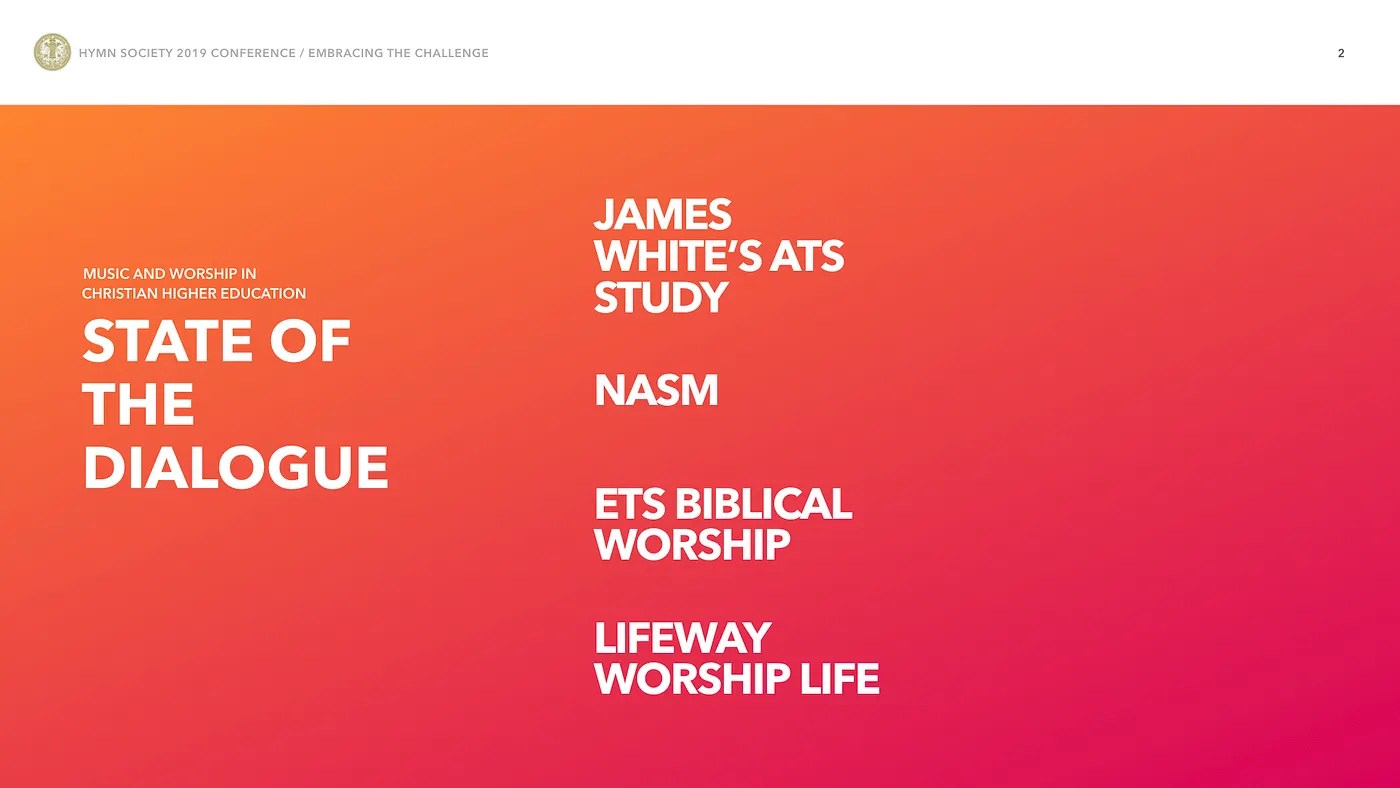
The last major published such study was conducted by Methodist educator and liturgical scholar James White in the early 1980s, where he examined the teaching of worship in North American seminaries. In this study of the institutions accredited by the Association of Theological Schools (ATS) and in partnership with said organization, White examined three areas of interest: 1) the content of worship and liturgical training; 2) who was teaching these courses; and 3) (in his words) the construction of “normative statements about what ought to be taught as the bare minimum.” While there are certainly lessons to be learned from White’s study, the landscape of worship training leadership has changed dramatically since its publication.
The need for further discussion in this area is evidenced by various informal attempts by those of us who teach in this field to consider pertinent issues. These gatherings have taken place at annual meetings of the National Association of Schools of Music, the Evangelical Theological Society, and most recently, a gathering of largely Southern Baptist educators of worship at the Lifeway WorshipLife event in Gatlinburg, Tennessee the previous two summers. Conversations at these meetings invariably revolve around the state of music in the evangelical church and the challenge that colleges, universities, and seminaries face as they seek to train future pastors and ministers who are equipped to lead and serve the church musically and theologically.
Check out the other posts in the Embracing the Challenge series:
- Research Methodology
- Question 1: What is the relationship between higher education and the local church?
- Question 2: Is the training of worship leadership primarily a theological discipline or a musical one?
- Question 3: What are the theological and aesthetic implications of our musical choices?
- Question 4: Is there a need for graduate music and worship leadership education in the twenty-first century?
- A Path Forward


 David M. Toledo, Ph.D
Leave a comment