This is Part 4 of 7 in Embracing the Challenge: Questions and Answers in Music and Worship in Christian Higher Education
A related question to the relationship between the church and seminary concerns the nature of worship leadership education. Is this training primarily a theological task or does it lie within the domain of music? For decades this task fell to the schools of music in the various denominational seminaries. The halls of these schools were filled by eager graduates of the denominational colleges and universities who would learn how to effectively provide leadership to congregational worship and broad comprehensive church music ministries. This is further evidenced by the comprehensive standards for church music degrees put forth both by ATS and the National Association of Schools of Music. These standards specified the graduate-level musical skills needed to lead the music of the church.
Somewhere along the way, we as church musicians became intoxicated with the “success” of our music ministries and ever-expanding cadre of musical ensembles, performances, and spectacles. In our leadership of the elaborate ministries, many of us lost sight of the important theological nature of the music and worship of the church. Musical excellence, a worthy and necessary goal of ministry, should never supersede the priority of theologically robust doctrine and practice in our worship traditions. Of course, there have always been faithful men and women who balanced these two purposes of musical excellence and theological rigor and served congregations well. Unfortunately, the stereotypes of the worship leaders who treat their positions as “gigs” and those who care more about the music than pastoring their flock still persist.
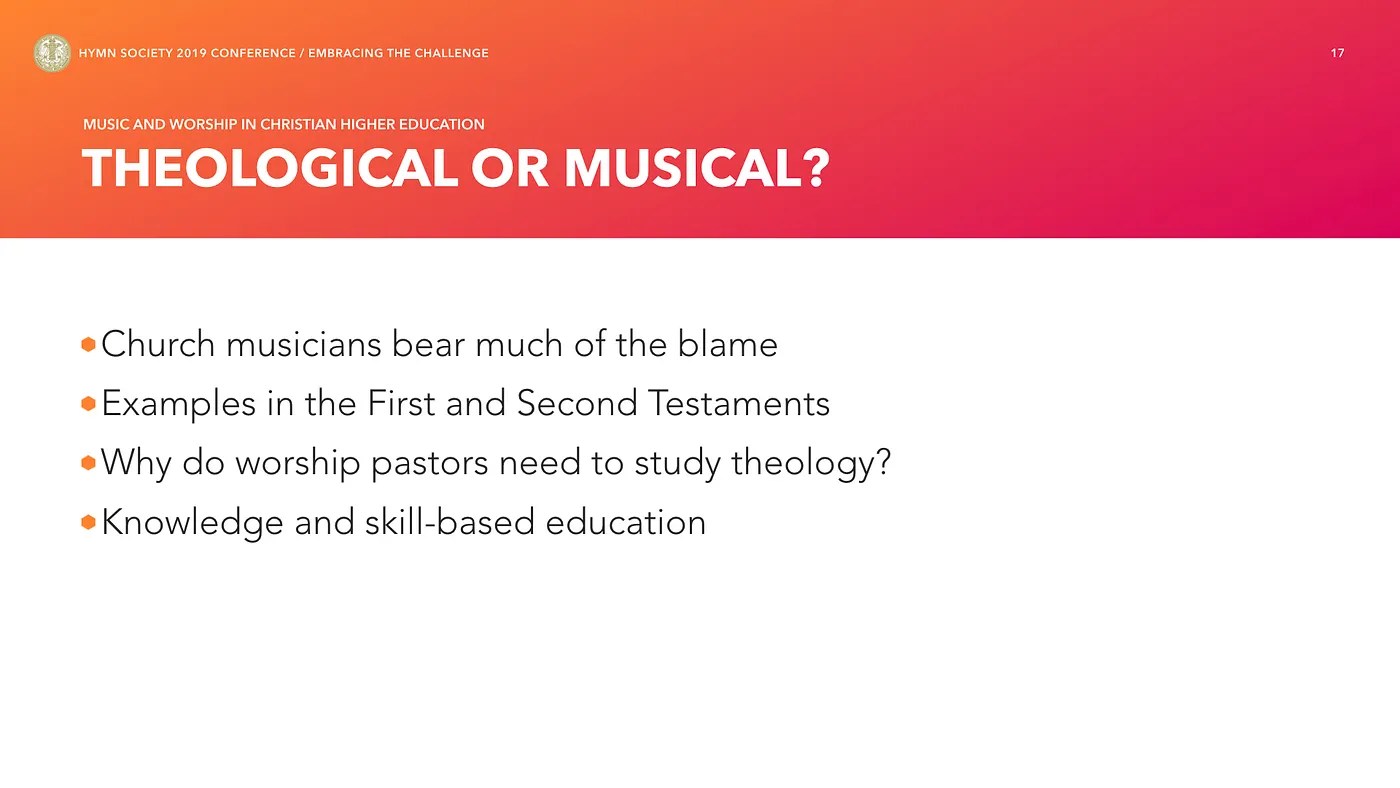
This leads to the critical question. Is worship training a theological or a musical task? A cursory study of worship in both the Old and New Testaments testifies to the need for both theological training and musical skill. The Levitical tribes were set apart by God for his service (Numbers 18). The priests and other Levitical leaders dedicated their lives to the study of the law of the Lord and the leadership of worship practices in the tabernacle and temple. They were exempted from other forms of work and received financial and material support from the other tribes of Israel. The New Testament clearly connects theology with worship, both in the teaching of Christ and Paul. Jesus’ famous discourse with the Samaritan woman in John 4 concludes with the astounding proclamation that “those who worship him must worship in spirit and truth.”¹ In his letter to the Colossians, Paul charges believers to “Let the word of Christ dwell in you richly, teaching and admonishing one another in all wisdom, singing psalms and hymns and spiritual songs, with thankfulness in your hearts to God.”² Clearly both Testaments speak to the priority of theology and doctrine in the preparation and practice of worship leadership.
Likewise, we find the call to musical excellence and preparation in both the First and Latter Covenants. When King David brought the Ark of the Covenant to his capitol city of Jerusalem, he charged the Levitical musicians to make elaborate music in the presence of the Lord. These same Levities who devoted themselves to the study of the Mosaic Law evidently formed familial guilds of musical training where fathers passed on their musical skill to the next generations. Notably, David names Cheneniah as the leader of the Levitical musical practices, “for he understood it.”³ In the New Testament, Paul encourages the church in Corinth to gather together in worship, to bring spiritual gifts, and to the teaching of the Word of God as well as songs of praise.⁴ Evidently Paul expected these lay members to have the ability to lead others in the singing of praise to God.
In a similar manner to the relationship between the local church and the seminary, worship leaders need training both in theology and musical skills to faithfully and effectively lead their congregations to worship God and to cultivate the musical and artistic giftedness of the people of God. Previously I have argued for the necessity of theological training of the worship leader. I contend that “the essential nature of theological training for the worship leader finds support from the witness of Scripture, the nature of worship itself, the structure and content of worship, the pastoral role of the worship leader, and the example of hundreds of years of Christian history.”⁵ Worship leaders must be trained to mine the depths of historical Christian theology and wrestle with complex theological issues such as the doctrine of the Trinity and the image of God in humanity, for they bear substantial influence on the patterns and practices of corporate worship. Seminaries must equip worship leaders with this framework of knowledge in order to effectively serve congregations.
The most academically prepared and theologically sound worship leader can fail spectacularly if he or she does not possess the appropriate musical skills to lead the worship and music of the church. Admittedly, sincere godly leaders have given congregations their voice in praise to God for centuries. However those who lack basic musical skills often struggle to move beyond common musical expressions of worship. If we are to take seriously the task of the stewardship of the giftedness of the people of God, then worship leaders must be equipped to cultivate and develop these artistic gifts. Often worship leaders can rely upon their inherent musical abilities to lead in worship, but lack the ability to train and guide others to make music to the Lord.
Worship and musical leadership is a skill that must be developed, not merely an intellectual concept to be apprehended. Musical training in worship leadership is akin to the homiletical and pedagogical development that accompanies various programs of pastoral training. John Witvliet helpfully reminds us, “Practices are things people do. Our study should not be limited merely to what people think about worship, how they think during worship, or whether or not they like what they are doing. A significant amount of energy should be reserved for encountering actual gestures, symbols, sermons, songs, images, and environments.”⁶ Just as the visual artist must understand fundamental aspects of design such as perspective, depth, and color, the worship musician needs the musical vocabulary to understand and effectively communicate aspects of music and lead others to make musical expressions themselves.
In order to minister well, worship leaders need to be able to correctly and clearly articulate the truths of the Word of God and lead themselves and others to make music in worship that reflects the historical and global diversity of the church while still speaking a word to the world today. J. Martin Scott recommends that,
an integrated approach to theological education will take seriously the development of all the senses, and seek to break down the compartmentalization that has characterized so much of traditional theology. The aim will thus be to find ways in which the whole self may be merged with the task of doing theology. As an inescapable part of life, music must surely have a place within a properly integrated approach to theology.⁷
The false dichotomy between theological and musical training must be destroyed and replaced with a robust training that holds theology and music in opposite hands, joining them together for the glory of God and the good of his church.
Check out the other posts in the Embracing the Challenge series:
- Introduction
- Research Methodology
- Question 1: What is the relationship between higher education and the local church?
- Question 2: Is the training of worship leadership primarily a theological discipline or a musical one?
- Question 3: What are the theological and aesthetic implications of our musical choices?
- Question 4: Is there a need for graduate music and worship leadership education in the twenty-first century?
- A Path Forward
[1] John 4:24, ESV.
[2] Colossians 3:16, ESV.
[3] 1 Chronicles 15:22, ESV.
[4] 1 Corinthians 14:26, ESV.
[5] David M. Toledo, “Why Worship Leaders Should Study Theology,” Artistic Theologian 2 (2013): 17.
[6] John D Witvliet, “Teaching Worship as a Christian Practice: Musing on Practical Theology and Pedagogy in Seminaries and Church-Related Colleges,” Perspectives 21, no. 6 (June 2006): 19.
[7] J. Martin C. Scott, “Playing in Tune: Music and Theological Education,” British Journal of Theological Education 11, no. 1 (August 2000): 48.


 David M. Toledo, Ph.D
Leave a comment