This is Part 6 of 7 in Embracing the Challenge: Questions and Answers in Music and Worship in Christian Higher Education
ATS provides a number of institutional data tables that are accessible from its website. These tables breakdown data by a host of factors, including headcount by degree programs. The earliest year that the ATS provides specific headcount for Master of Church Music (and other similar music-related degrees) is 1988 with a total headcount of 553 students. The recorded apex of head count enrollment occurred in 1992 with 567 students enrolled in graduate music programs in theological institutions. As we have already noted, this data does not include other types of MA programs or other non-musical worship-related programs. Regardless of one’s position on the necessity of graduate church music education, it’s a startling decline from 567 in 1992 to 98 students in 2017.
This raw data forces those of us in the business of training future church musicians and worship leaders to ask hard questions about our programs. Is there still a need for graduate church music and worship leadership education in our theological schools? Are Christian colleges and universities filling this gap and providing training that formerly took place in our institutions? Are students opting to forgo graduate music education in favor of traditional theological programs such as the MDiv or MTS?
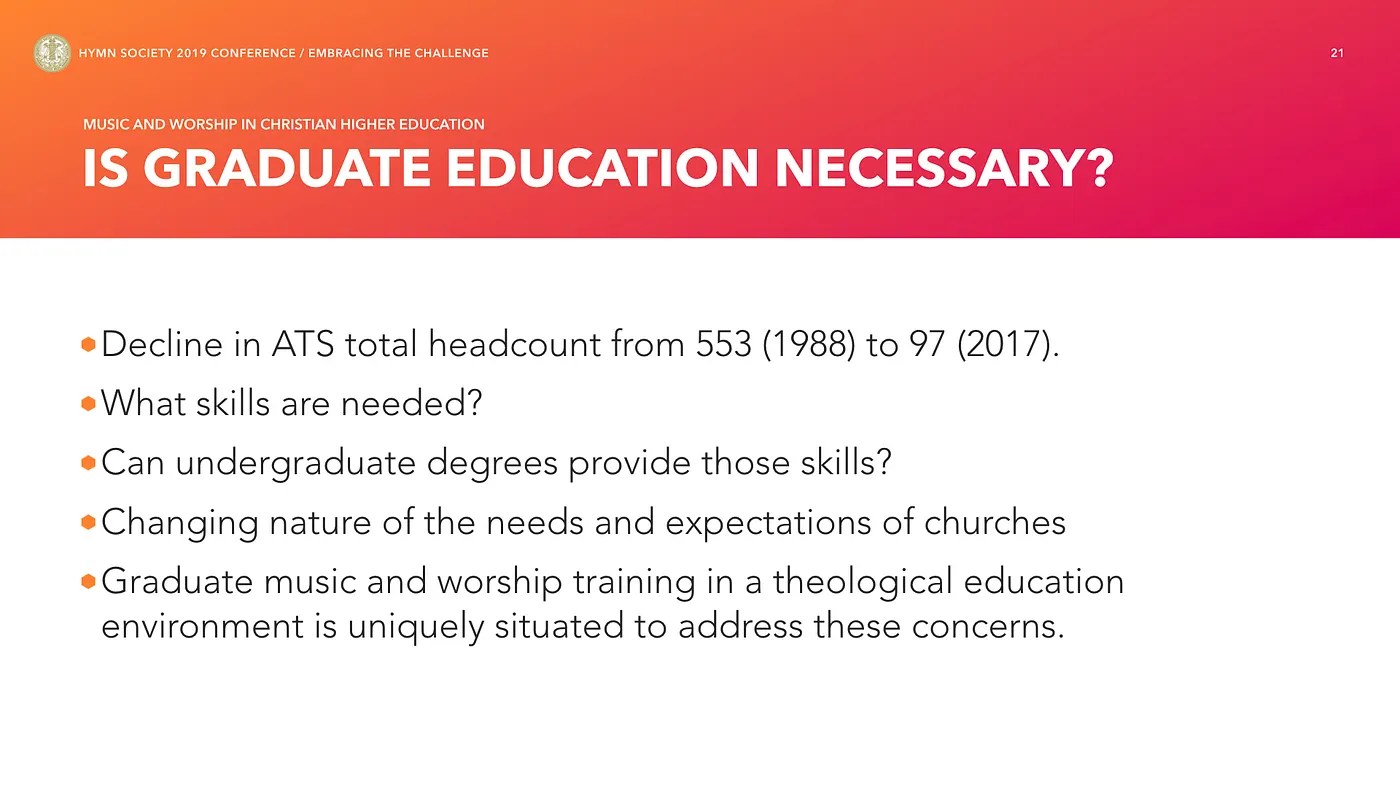
Certainly the dramatic changes in worship practices in the local church have factored into this statistical decline. Whereas formerly church musicians and worship leaders needed advanced training in musical skills such as hymnody, conducting, and music education, many churches have scaled back their musical offerings to a small number of worship band musicians, who are often paid professional musicians. Without a choir, orchestra, or graded-children’s choir program, many prospective students are failing to see the need for graduate church music or worship education. Can an undergraduate program in worship studies provide the skills necessary for someone to have a lifetime of training and leading worshipers in the local church? Yes, but there is tremendous value in receiving graduate level training in the areas of musical and worship leadership.
Often it is in graduate study where students are given tangible responsibilities in the leadership of others in music. As an undergraduate, the primary goal for a student is to gain a body of knowledge and develop his or her personal musical skill. One of the distinctives of graduate music education is the development of musical leadership skills through means of practica, conducting courses, and other supervised environments. The landscape of the music of the church has changed dramatically the past decades, and students need every chance to prepare themselves for the challenges that are readily apparent as well as those that lie beyond the horizon. Advanced musical training provides these tools and experiences to cultivate the musicians who not only can “perform” on their own, but can lead other musicians to develop their own giftedness.
Quite simply, the theological aspect of worship studies is too complex to be treated comprehensively on an undergraduate level. Likewise, the student who forgoes graduate training in worship leadership to pursue a traditional theological degree will likely not encounter the type of theological, philosophical, and intellectual questions that are broached in graduate study in music and worship. Graduate study moves students from questions regarding “what” and “how” to the deeper questions of “why” and “should we?” Graduate study in music and worship provides greater opportunity to develop mentoring relationships between student and faculty that will bear much fruit throughout the lifetime of ministry.
Graduate study in music and worship must hold in tension the commitment to excellence with the desire to be practical. Administrators and faculty must have the courage to critically evaluate curricula in light of present realities and not idealized scenarios that have not existed for years. Educators must interact with a variety of musical styles, both popular and global, as well as traditional Western classical styles. These new approaches must not be viewed as inferior, but rather should be appreciated and cultivated with stylistic integrity, celebrating the artistry that is stylistically appropriate. The secular world of music education recognizes the need to adapt traditional music education for a new paradigm. In a recent publication, College Music Curricula for a New Century, Robin Moore notes,
Ultimately, institutional music education cannot afford to ignore popular music, the form of expression most students and audiences experience each day and are most comfortable with. The constant shifting of popular repertoires creates challenges for curricula but caters more directly to the cultural and class backgrounds of a diverse student body and allows for the foregrounding of student knowledge.¹
Graduate programs of music and worship in theological education can learn from our secular counterparts and approach these new styles as opportunities to grow and develop creatively and not as obstacles which must be ignored or overcome. We cannot expect our students to critically encourage cultural expressions of music and other art forms if we dismiss them out of hand. We must review the curricula through a wide lens that takes the broad set of skills needed by twenty-first century worship leaders and incorporate these new approaches into traditional music education.
Check out the other posts in the Embracing the Challenge series:
- Introduction
- Question 1: What is the relationship between higher education and the local church?
- Question 2: Is the training of worship leadership primarily a theological discipline or a musical one?
- Question 3: What are the theological and aesthetic implications of our musical choices?
- Question 4: Is there a need for graduate music and worship leadership education in the twenty-first century?
- A Path Forward
[1] Robin D. Moore, ed., College Music Curricula for a New Century (New York, NY: Oxford University Press, 2017), 15.


 David M. Toledo, Ph.D
Leave a comment