
This is Part 2 of 7 in Embracing the Challenge: Questions and Answers in Music and Worship in Christian Higher Education.
In order to comprehensively and manageably address these concerns, I conducted research from two pools of institutions, in which there is some overlap. The first group from which I will share consists of institutions that are members of the National Association of Schools of Music (NASM). NASM is an organization of various types of schools of music that “establishes national standards for undergraduate and graduate degrees and other credentials for music and music-related disciplines, and provides assistance to institutions and individuals engaged in artistic, scholarly, educational, and other music-related endeavors.”¹ The member institutions come from a broad cross-section of schools in the United States ranging from small religious liberal arts colleges to major R1 public universities.
NASM maintains a listing for each member institution on its website that provides both general information regarding the school as well as specific degrees that are accredited by NASM in the various musical disciplines. It designates which programs have received full plan approval, specific concentrations within those degrees, and new degrees or programs that have received provisional approval. Through a meticulous search of each of the member institutions, I compiled a listing of degree programs relating to various aspects of church music study. The findings demonstrate the rich diversity of sacred music/worship training across denominational and geographical lines.
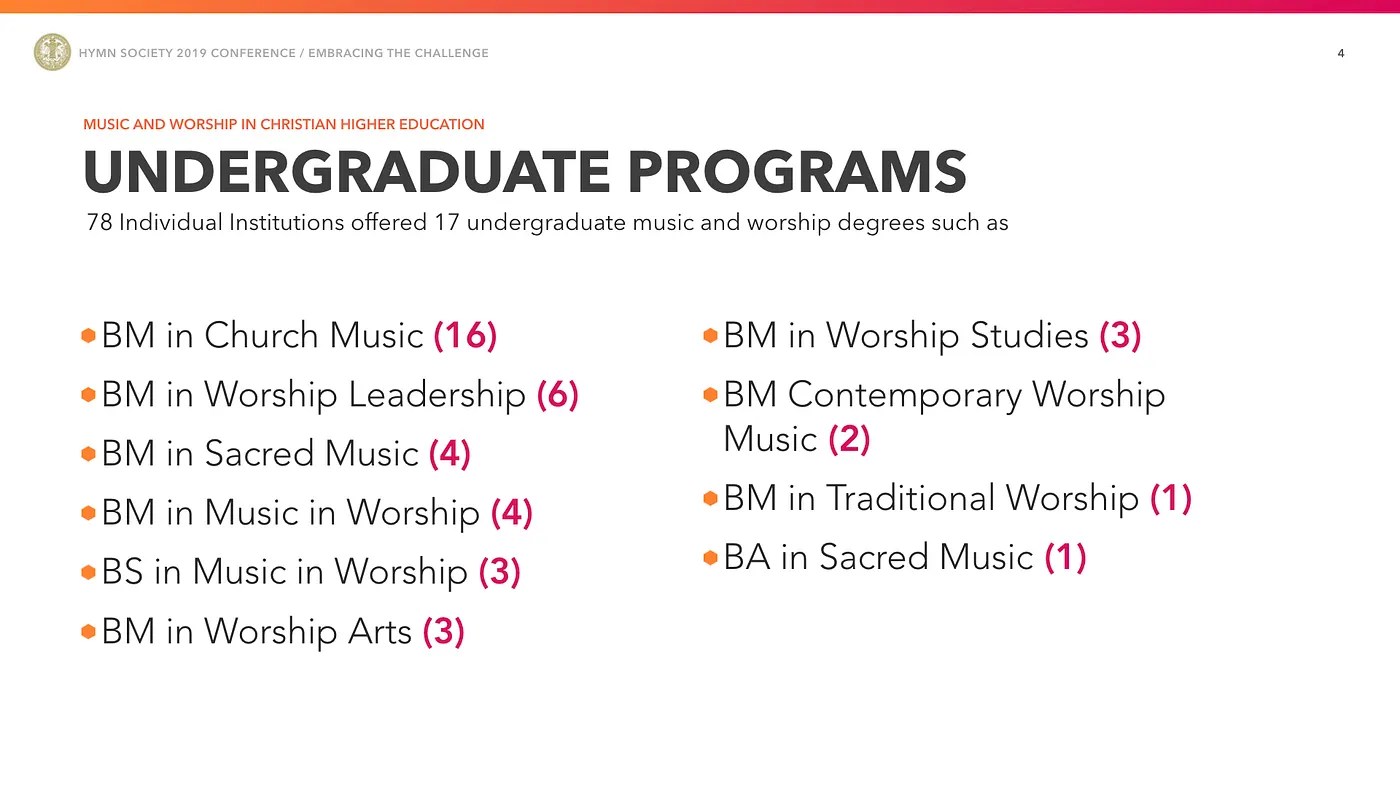
There were seventeen (17) different undergraduate degree programs from seventy-eight (78) individual institutions. A cursory glance at the divergent degree program names demonstrates the various philosophical, musical, and theological approaches to worship training undertaken by these schools. The BM in Church Music continues to be the most commonly offered degree program with 16 schools, followed by the BM in Worship Leadership (6). Other programs include various BA and BM degrees in Sacred Music, Music in Worship, Worship Leaders, and even Traditional Worship!
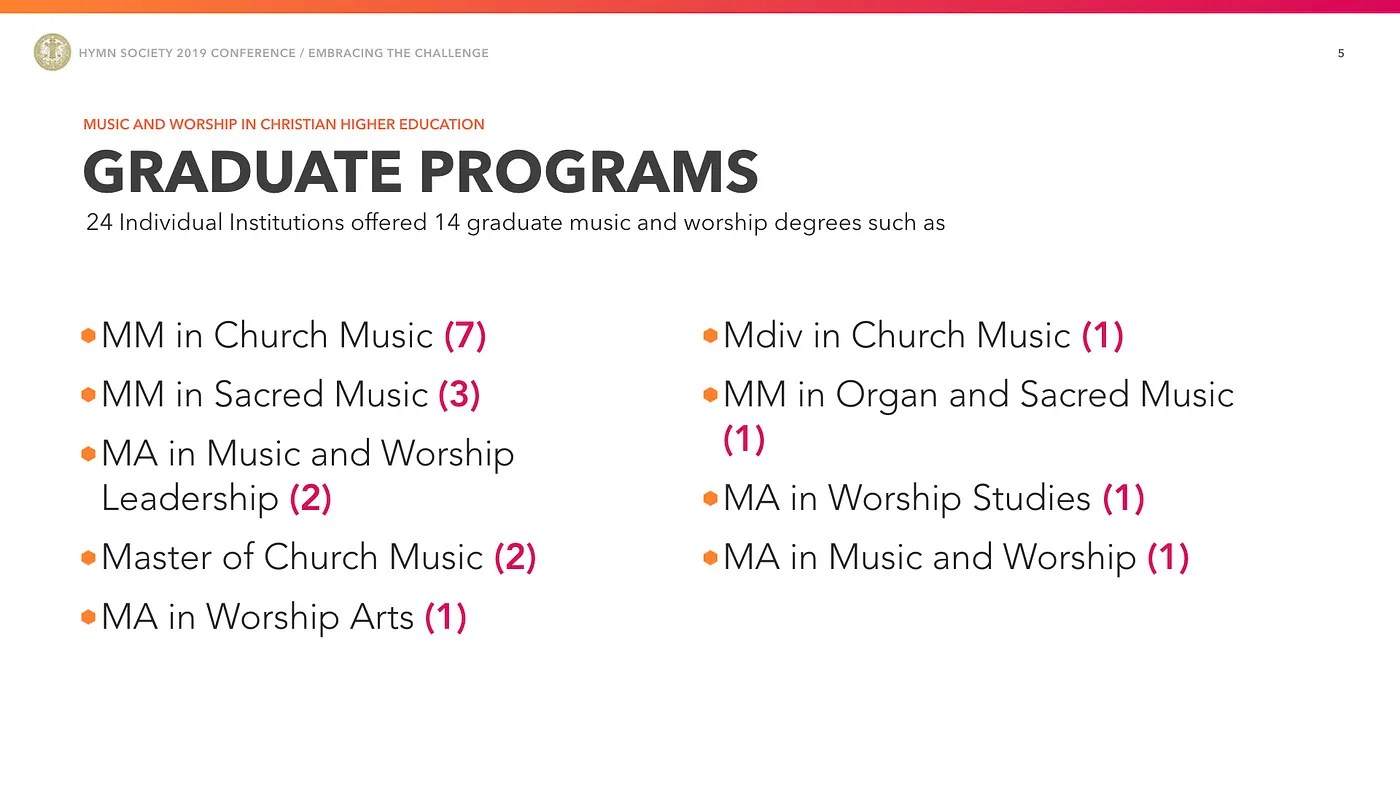
On the graduate level, NASM accredits 14 programs of study across 24 schools. These degrees include MA, MDiv, and and MM courses of study. The MM in Church Music (7) remains the most widely offered program, but seven different MA programs are accredited as well. The MA offers greater flexibility in adapting curriculum to theological, musical, and practical training. Consequently, schools desiring to specialize in differing “worship” training programs tend to go that route, rather than a traditional MM program. Five schools offer NASM accredited doctoral programs in church or sacred music programs — Indiana University, New Orleans Baptist Theological Seminary, Baylor University, Southwestern Baptist Theological Seminary, and The Catholic University of America.
The second cohort that I studied is made up of institutions who seek accreditation from the Association of Theological Schools (ATS). This focused band of study allows the research to demonstrate changes in those schools whose primary commitments are to theological education and the professional training and development of clergy, ministers, and pastors of churches from across denominations.
The Association of Theological Schools consists of over 270 graduate schools of theology who “conduct post-baccalaureate professional and academic degree programs to educate persons for the practice of ministry and for teaching and research in the theological disciplines.”² ATS provides degree program standards for courses of study that deal with the areas of music and worship leadership to varying extents. These degree programs include the Master of Divinity (MDiv), Master of Music in Church Music (MM in Church Music), Master of Arts (MA), Doctor of Ministry (DMin), and Doctor of Philosophy (PhD).
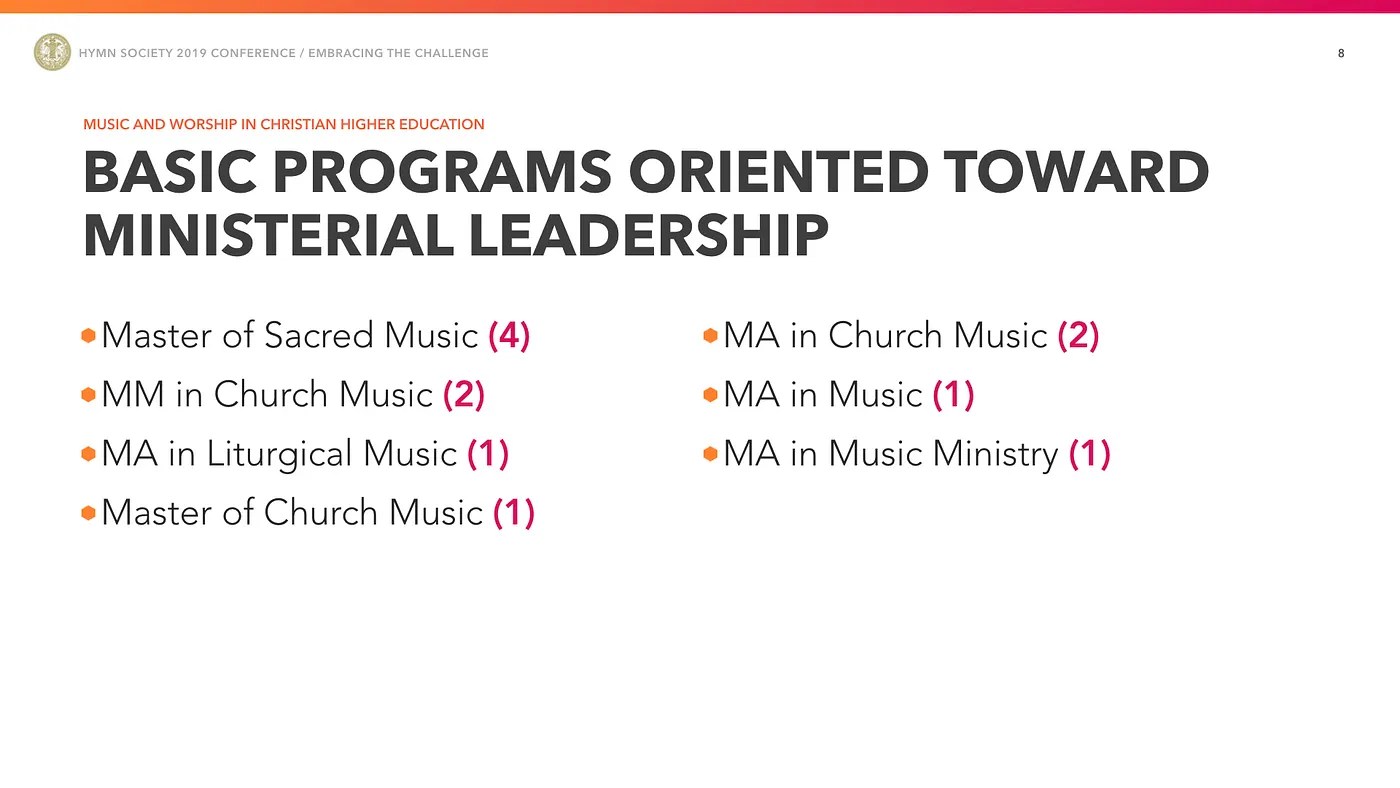
According to its list of Approved Degrees, ATS currently provides accreditation to twelve “basic programs oriented toward ministerial leadership.”³ These degrees include the Master of Sacred Music (4), the Master of Music in Church Music (2), the Master of Arts in Liturgical Music (1), the Master of Church Music (1), the Master of Arts in Church Music (2), the Master of Arts in Music (1), and the Master of Arts in Music Ministry (1).
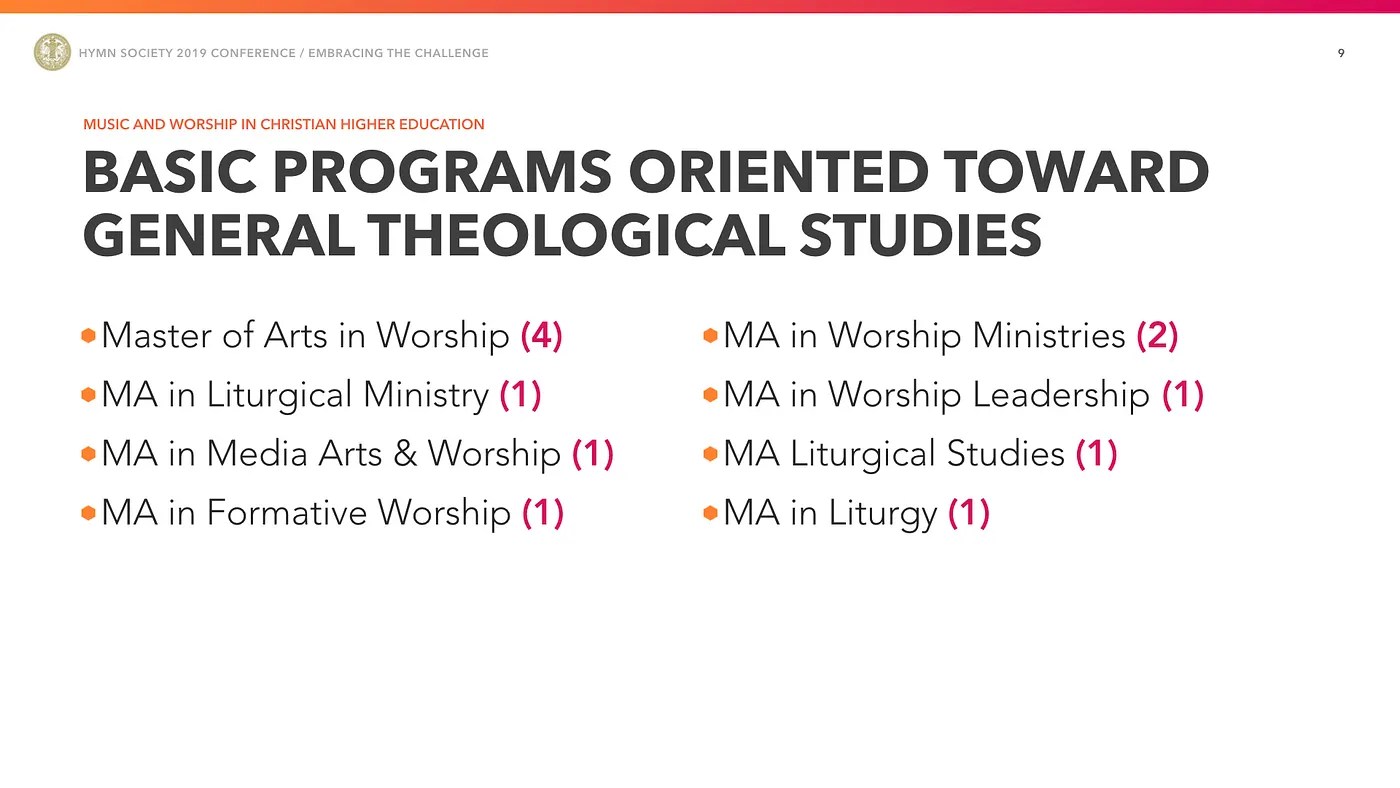
It also accredits twelve “basic programs oriented toward general theological studies,” including the Master of Arts in Worship (4), the Master of Arts in Liturgical Ministry (1), the Master of Arts in Media Arts and Worship (1), the Master of Arts in Formative Worship (1), the Master of Arts in Worship Ministries (2), the Master of Arts in Worship Leadership (1), the Master of Arts in Liturgical Studies (1), and the Master of Arts in Liturgy (1).
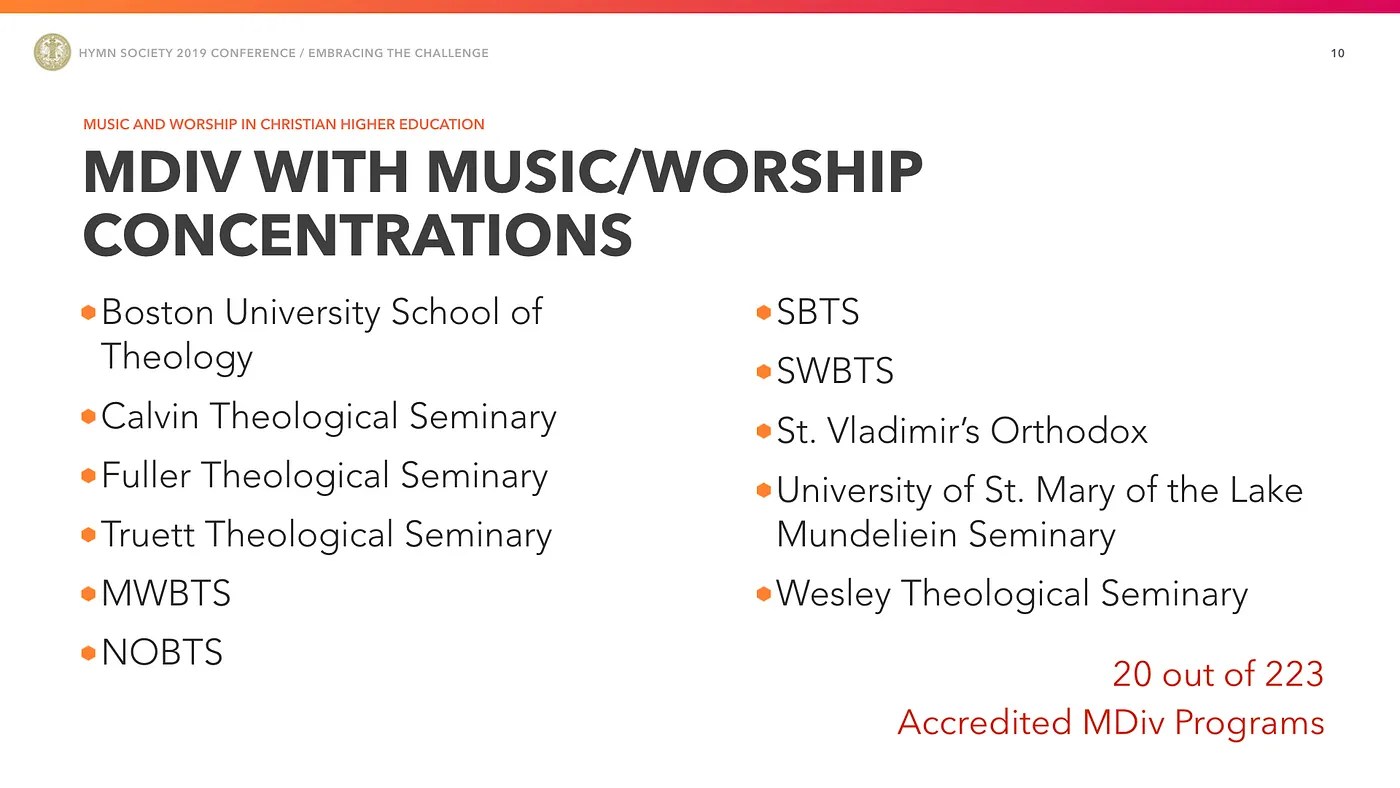
The flagship degree for most theological schools is the Master of Divinity. ATS accredits the MDiv at 223 institutions. 18 of these schools have concentrations within the MDiv in areas related to worship, church music, liturgical arts, and the worship arts. Two other programs do not have a specific concentration in music or worship, but have a music proficiency requirement or a substantial portion of the core curriculum devoted to music. Interestingly, these two schools represent the Orthodox and Roman Catholic traditions.
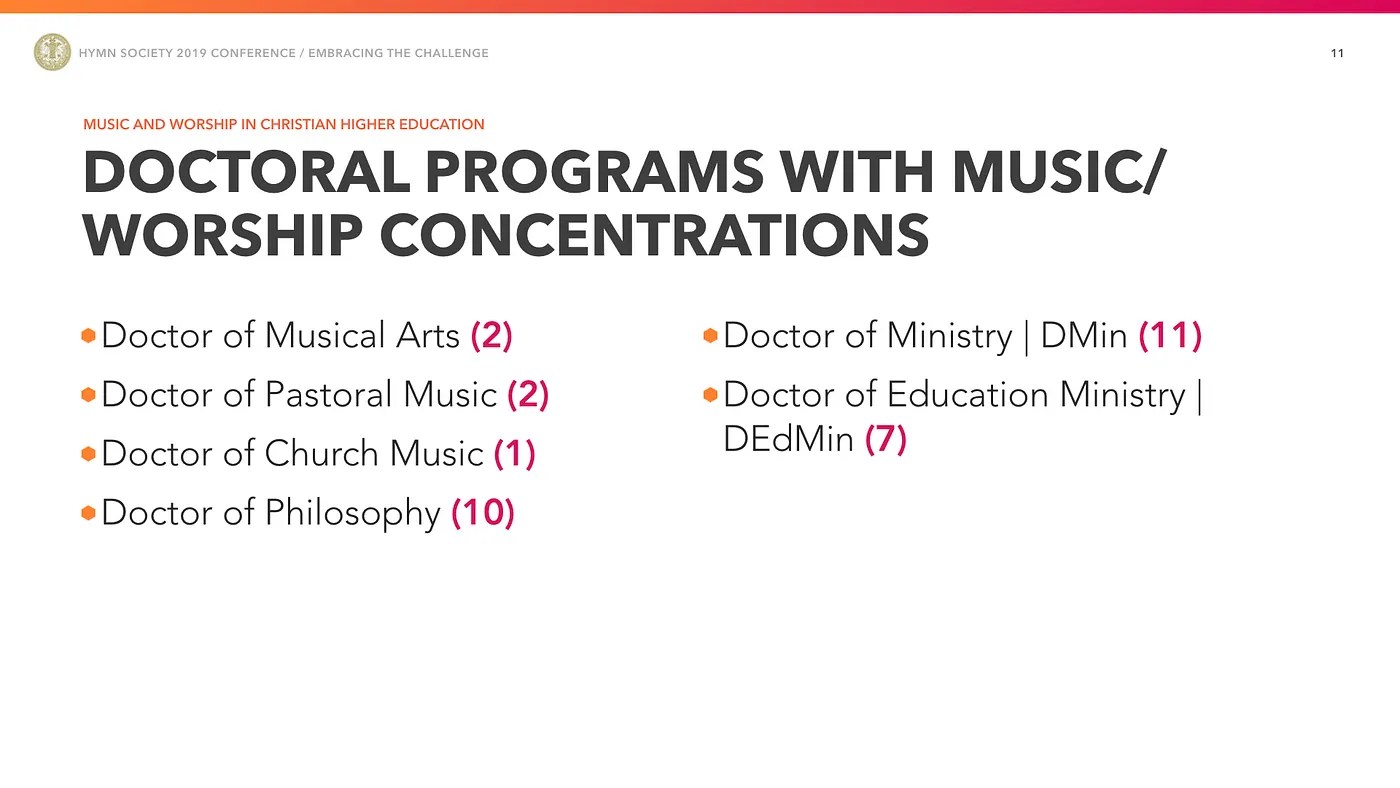
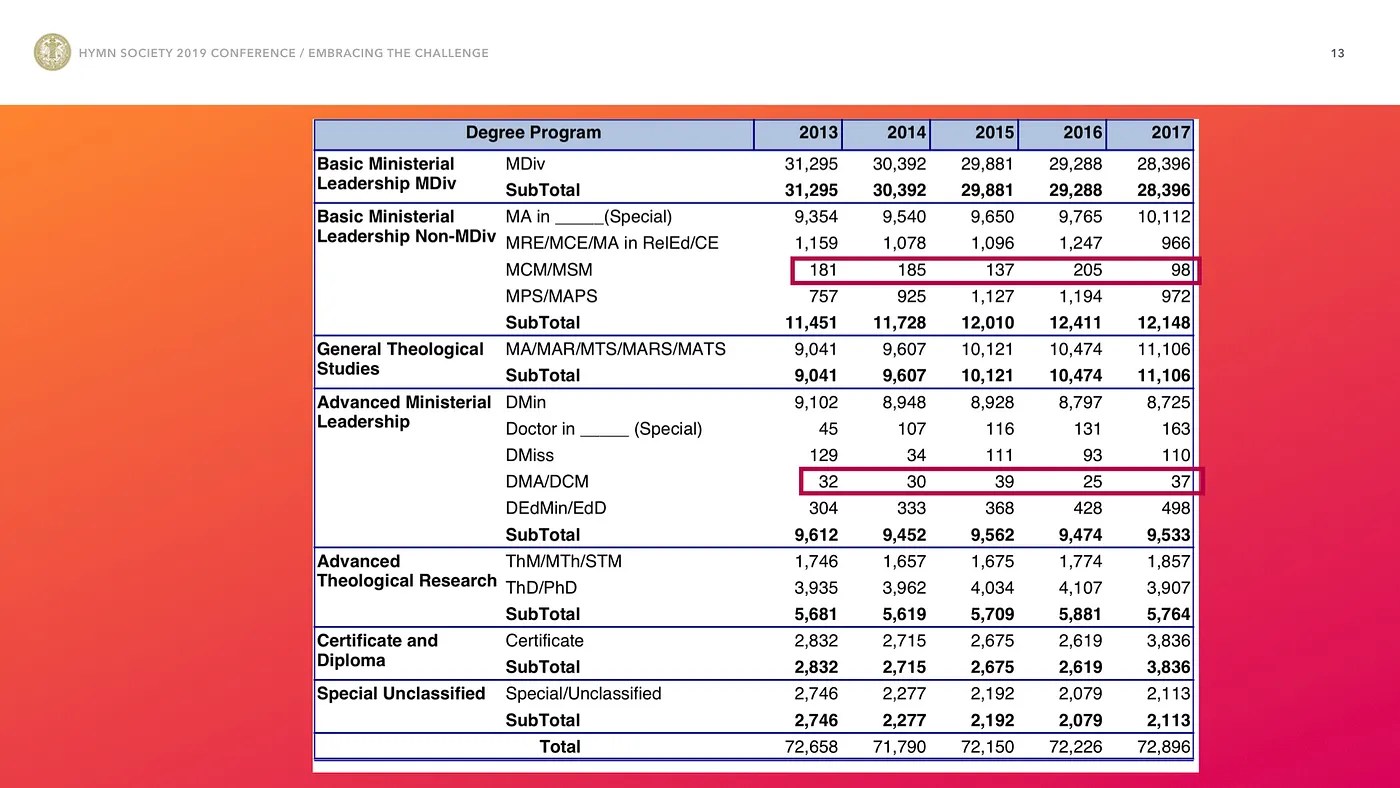
On the doctoral level, ATS recognizes a variety of research and professional programs. Currently four institutions offer doctoral programs in church music including the Doctor of Musical Arts (2), the Doctor of Pastoral Music (1), and the Doctor of Church Music (1). Additionally ten schools offer PhD programs with concentrations in worship, music ministry, liturgical studies, and other worship-related disciplines. Other professional doctoral programs with music and worship concentrations include the Doctor of Ministry (DMin) (11 schools) and the Doctor of Education Ministry (DEdMin) (7 schools).
In its 2017–2018 Annual Data Table, ATS affiliated institutions recorded a total head count of 72,896 students and a full-time equivalency of 45,855 students in their various programs of study. While specific enrollment data in the various concentrations of non-music specific degrees is not available, according to the Table 2.10-A Head Count Enrollment by Degree Category and Program, All Member Schools, 98 students are enrolled in the MCM, MSM, and MMCM programs in the United States and Canada. This is a marked downturn from 205 reported in 2016. What was once the primary seminary graduate degree for ministers of music, worship pastors, and other church musicians is in substantial decline.
In light of these statistics regarding theological training in music and worship, as well as the changing landscape of practices in the local church, I will raise and hopefully answer several questions that encapsulate the challenges in our field. First, I ask what is the relationship between institutions of Christian higher education and the local church? Specifically, I will address the obligations that each of these parties have with regard to each other and how these relationships shape the training of future worship leaders. Second, I examine the nature of worship leadership training — is it primarily a theological or a musical task. Next I ask if there are theological and aesthetic implications to the type of music that is used in the local church and taught by our schools, or have we relegated music to a matter of personal preference? Lastly I ask the difficult question of whether graduate music and worship training is necessary in today’s church culture and environment.
Check out the other posts in the Embracing the Challenge series:
- Introduction
- Question 1: What is the relationship between higher education and the local church?
- Question 2: Is the training of worship leadership primarily a theological discipline or a musical one?
- Question 3: What are the theological and aesthetic implications of our musical choices?
- Question 4: Is there a need for graduate music and worship leadership education in the twenty-first century?
- A Path Forward
[1] “Home.” National Association of Schools of Music. Accessed July 15, 2019. https://nasm.arts-accredit.org/.
[2] “About ATS | The Association of Theological Schools,” accessed October 27, 2018, https://www.ats.edu/about.
[3] “Approved Degrees | The Association of Theological Schools,” accessed October 27, 2018, https://www.ats.edu/member-schools/approved-degrees.


 David M. Toledo, Ph.D
Leave a comment