This is Part 5 of 7 in Embracing the Challenge: Questions and Answers in Music and Worship in Christian Higher Education
As seminaries train worship leaders to faithfully practice theology and doxology, a corollary question emerges regarding the practice of music making in the church. What are the theological and aesthetic implications of the music making found in congregations? Should seminaries hold to the traditional model of church music education that emphasized the Western Classical tradition or should it embrace styles of music greatly influenced by popular culture and music? These questions have been a source of consternation and considerable debate in recent decades as worship wars have raged across the denominational spectrum.
My goal here is not to put an end to these worship wars, regardless of how much we would all wish they would end! Our task concerns the nature and future of worship leadership education in seminaries. Are we equipping our students with the necessary knowledge, skills, and wisdom to navigate these tumultuous waters? Or have we relegated musical style to a matter of personal and congregational preference, thereby adjusting our education to the music that is happening in the church today?
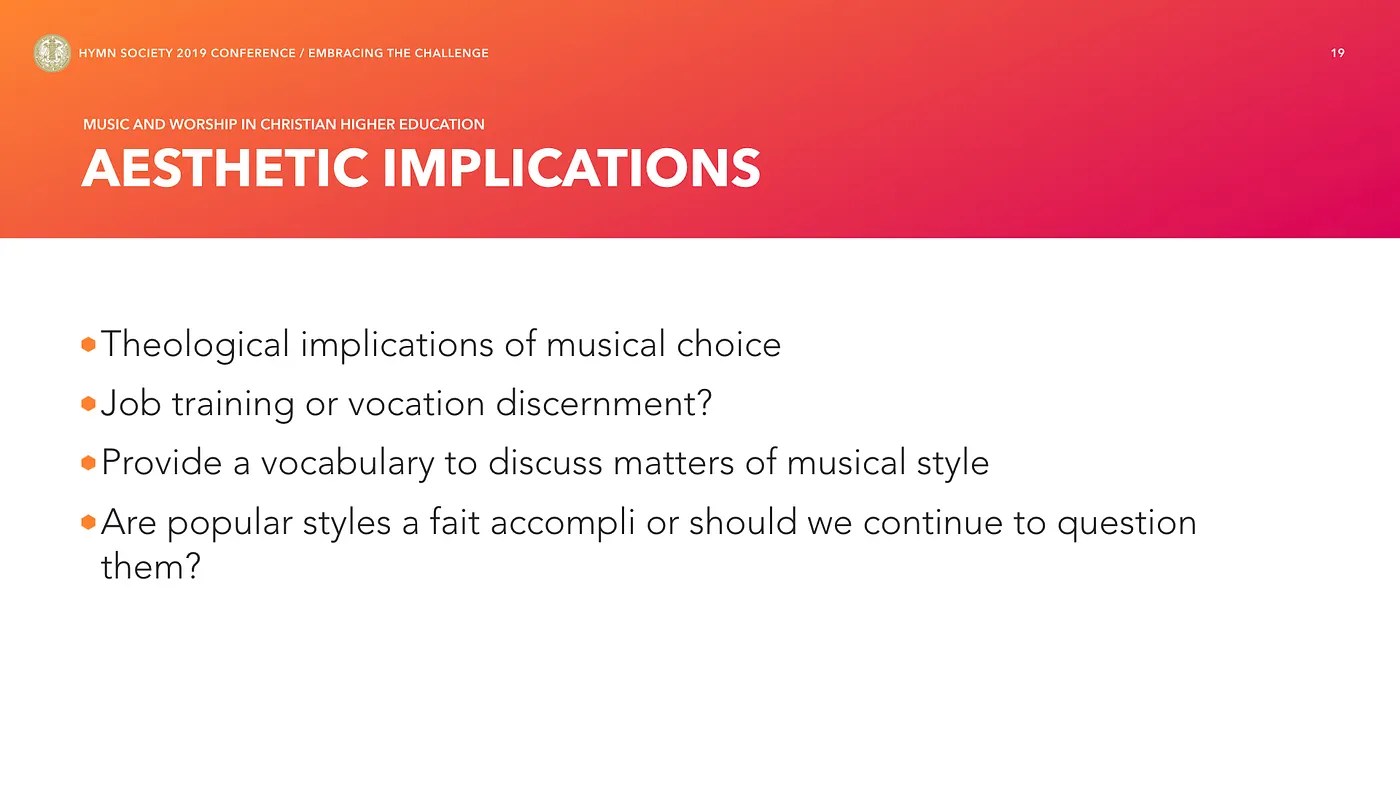
These are difficult questions with answers that often elude our grasp. Several important aspects of this dilemma require further examination. First, our institutions must determine their ultimate purpose. Is graduate theological education professional job training or is it something more? The rising costs associated with higher education as well as a more complex job market have forced many prospective students to seek the bottom line when it comes to their education. What will the return on investment be? Will they be able to get a job when they graduate? These concerns are valid and schools must ensure that they provide significant value for the investment of time and resources that our students commit to their education.
One way in which schools can reshape the discussion over musical style is to recapture the historical understanding of “vocation.” This term is used commonly as a synonym with “profession,” but a clearer understanding recovers its meaning as a divine call imbued with purpose and meaning. By training worship leaders to think theologically and lead pastorally, we provide them the tools to wrestle with the implications of musical choice. Critical aspects of the pastoral role include providing spiritual sustenance in the Word and protecting the flock from harmful outside influences.
Matters of musical style fall into the broad philosophical category of aesthetics, which itself is a dimension of theological study. Historically the question of beauty and quality ultimately related back to a concept of universal structure and order that reflected the divine Creator. A whole host of factors have led to a shift in the prevailing thinking regarding beauty and appropriateness. Munson and Drake effectively capture the current intellectual millieu:
You may think something is pleasant, and I may think something else is pleasant, but one or both of us may not know what true pleasure is. In fact, we may be drawn to that which will make us miserable. It’s precisely because we are so prone to decide ourselves about pleasure that we need the concept of beauty. It enables us to think critically about pleasure, which, by the way, is why postmoderns hate beauty so much and want to conflate it with preference.¹
Thinking about matters of style is not a matter of preference, but is rather a philosophical and theological task. Our theological institutions must take matters of culture, philosophy, and art seriously and equip our students to wrestle with them. The goal of our training is not to press a musical or stylistic agenda. To the contrary, our goal is to enable our students to think cogently and act pastorally, rather than treating matters of style as preferential and value-neutral. It is precisely within theological education that these discussion must occur.
Check out the other posts in the Embracing the Challenge series:
- Introduction
- Question 1: What is the relationship between higher education and the local church?
- Question 2: Is the training of worship leadership primarily a theological discipline or a musical one?
- Question 3: What are the theological and aesthetic implications of our musical choices?
- Question 4: Is there a need for graduate music and worship leadership education in the twenty-first century?
- A Path Forward
[1] Paul Allen Munson and Joshua Farris Drake, Art and Music: A Student’s Guide, Reclaiming the Christian Intellectual Tradition (Wheaton, IL: Crossway, 2014), 25–26.


 David M. Toledo, Ph.D
Leave a comment