This is Part 3 of 7 in Embracing the Challenge: Questions and Answers in Music and Worship in Christian Higher Education.
Perhaps, the most determinative question regarding music and worship leadership education pertains to the relationship between the seminaries and theological schools and the local church congregations that make up their constituencies. Do the seminaries exist to serve the local church? For those seminaries that are denominationally sponsored and supported, the answer is a resounding affirmative. Larry McKinney helpfully notes,
Simply put, our programs of theological education must be inextricably linked to the church. At every level of design and operation, theological education must be sensitive to the needs and expectations of local congregations. Our programs must become manifestations of the church, through the church, and for the church. The academy must be a resource center for the church as we join hands with local church practitioners.¹
The difficulty lies in determining what this means on an institutional and curricular level. Do seminaries view the local church as a market for their graduates? Do seminaries have a prophetic role in guiding the conversations that churches have regarding music and worship? Do the churches view the seminaries as places that provide viable and practical skills that are necessary for ministry in the twenty-first century?
The answers to these questions will shape the decision making process of institutions. Past-president of ATS, David Aleshire discussed this unique relationship in his 2004 plenary address at the ATS Biennial Meeting,
Most seminaries were founded by church bodies, or struggles within ecclesial communities, or religious movements that, typically, mature into church bodies. Most theological schools continue in some pattern of relationship. There is no parallel in other forms of graduate professional education.²
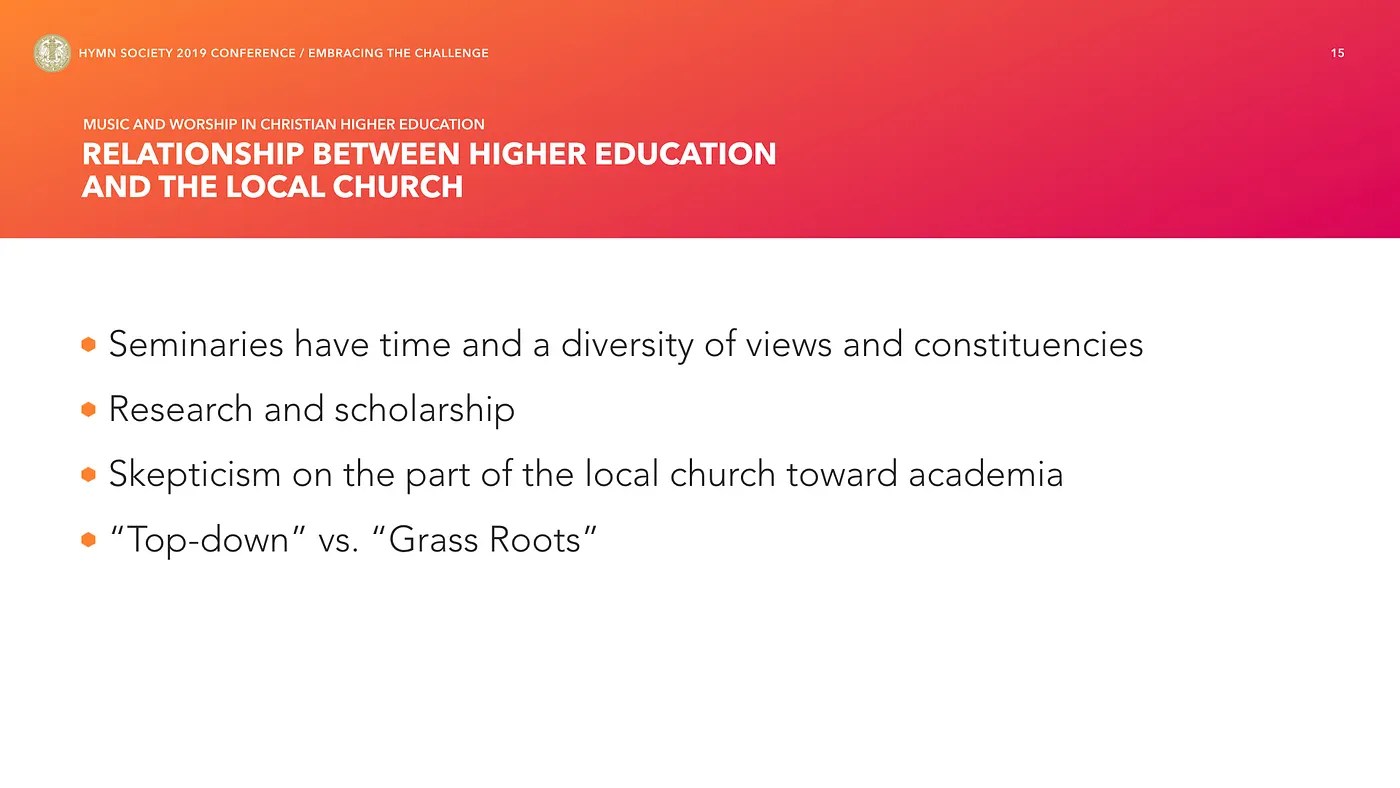
Seminaries have the valuable perspectives of history and diversity when making decisions. These schools have the ability to look objectively at the changes in worship practices and make long-term decisions rather than reacting to change as rapidly as the local church. This is both a blessing and a curse. David Dockery calls for Christian institutions to not only train for a vocation, but prepare students “to think Christianly, to think critically, to think imaginatively — preparing them for leadership and preparing them for life.”³ Students must be given a theological foundation, philosophical worldview, and a diverse skill set so that they will thrive for a lifetime of ministry and not merely their first position after graduation.
The primary task of a seminary is to train future ministers and pastors, but another critical task is the research and scholarship that will nourish and challenge the church for decades to come. Part of this process is to stand as an objective voice that will lovingly encourage the local church in its ministry, as well as lovingly correct when its practices stray from the biblical witness and take their cues from the society at large. In the area of worship and music leadership, the seminaries have long resisted adaptation for a host of reasons. Many of the leading schools of music in the seminaries were led by godly musicians and scholars who enjoyed successful and lengthy tenures. Often the changes observed in the church culture ran contrary to the advanced training and experience of these educational leaders. Other institutions experienced dramatic change and saw wholesale turnover its music and worship faculty, resulting in a great deal of mistrust and antipathy on the part of educators toward certain denominational leaders and movements across the political and theological spectrums. Skirmishes over music and worship traditions have often proxy battles in larger theological wars between strongly held denominational positions.
On the other hand, the local church has often looked hopefully and yet skeptically toward its seminaries for leadership. For a host of reasons that are beyond the scope of this paper, theologically conservative churches have embraced popular styles of music and worship forms, while more moderate and liberal churches have tended to maintain their liturgical traditions and historical practices. This has led to an association of “classical” music education in the seminary with outdated methodologies of church growth and leadership, or worse, theological liberalism. This skepticism toward higher education and seminary training is nothing new among fundamentalists of various denominations. Timothy Weber has noted that “growing numbers of religious leaders no longer believe that a seminary education is necessary for effective church leadership. In fact, many are arguing that pastoral leaders are better off without it.”⁴ The growing influence of notable churches and worship artists such as Hillsong, Gateway Church, New Life Church, and Bethel is evidenced by the various non-accredited, yet growing schools of worship or ministry sponsored by these organizations. The local churches are looking to the seminaries for leadership in the area of music and leadership and many are not finding the answers they seek.
The reality is that church and the seminaries need each other in order to fulfill their missions and transform the world with the Gospel of Christ. The seminaries must seek to guide, inform, and gently correct the practices of future minsters and thereby shaping the practices of congregations in the future. This task will be informed by ongoing scholarship in the areas of music, worship, and theology by the committed faculty members of these schools. This “top-down” approach will eventually filter down throughout the member churches as graduates take roles of leadership in the local church.
Likewise, the local church will serve as a “grass-roots” source of musical and worship reform. The needs of individual congregations shape both the content and the delivery of the curricula in the seminaries. Churches influence the directions of seminaries in the way in which they express support from the pulpit and through social media, the number of students they send to be trained in these schools and to which schools they send their prospects, and lastly by the direct financial support of these schools through institutional gifts and endowments.
Check out the other posts in the Embracing the Challenge series:
- Introduction
- Question 1: What is the relationship between higher education and the local church?
- Question 2: Is the training of worship leadership primarily a theological discipline or a musical one?
- Question 3: What are the theological and aesthetic implications of our musical choices?
- Question 4: Is there a need for graduate music and worship leadership education in the twenty-first century?
- A Path Forward
[1] Larry J. McKinney, “Evangelical Theological Higher Education: Past Commitments, Present Realities, and Future Considerations,” Christian Higher Education 3, no. 2 (April 1, 2004): 158.
[2] Daniel O Aleshire, “Theological Schools and the Church: Finding a Future Together,” in Plenary Address (ATS Biennial Meeting, Pittsburg, PA, 2004).
[3] David S. Dockery, Renewing Minds: Serving Church and Society through Christian Higher Education (Nashville, TN: B&H Academic, 2008), 20.
[4] Timothy P Weber, “The Seminaries and the Churches: Looking for New Relationships,” Theological Education 44, no. 1 (2008): 81.


 David M. Toledo, Ph.D
Leave a comment